
Koenig & Wernicke Antique Bisque Dolls 1912+ German Information

ca. 1916 Koenig & Wernicke doll mold 90 Butterfly Baby doll 13″ tall a bisque head Asian or Oriental doll, composition jointed body, doll mark Butterfly Baby 90 Made in Germany.
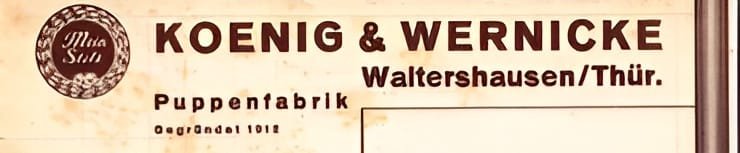
Koenig & Wernicke Puppenfabrik, founded in 1912, Waltershausen, Thur. letterhead
Max Koenig (sometimes mis-spelled in reference books as Konig), along with Max and August Rudolph founded in 1911 the Koenig & Rudolph Puppenfabrik (doll factory) in Waltershausen, Thüringia, Germany. In 1912 the two Mr. Rudolph’s left the company and Rudolph Wernicke joined the firm and the company name was changed to Koenig & Wernicke as shown above on the company letterhead.
The Koenig & Wernicke bisque head dolls were supplied by the porcelain factories of Bahr & Pröschild, Hertel, Schwab & Company and Armand Marseille. They also made celluloid dolls, as the KW doll mark contains the Schildkrot turtle symbol as well and rubber dolls. In 1931 Koenig & Wernicke purchased the doll factory of Adolf Wislizenus.
Some Koenig & Wernicke doll trade names are: My Playmate doll – Mein Spielgefährte and 1914+ My Pride doll – Mein Stolz doll mold 4711, both dolls were distributed in the USA by George Borgfeldt., ca. 1916 Butterfly Baby doll mold 90, 1935+ K & W Nicaput is a painted hard rubber doll. Koenig & Wernicke made bisque head black or white Dolly face, character Baby or character dolls, some with flirty eyes and voice boxes, all of good quality.
After world war II the Koenig & Wernicke company moved to Dornstetten, Germany. Sometime in the 1950s the company name changed to Rolf Wernicke Kommanditgesellschaft (KG) and by now was making plastic and then vinyl dolls. In the 1980s the name was changed to Puppenwerkstatt Wernicke GmbH. and by the mid 1990s all company operations ceased.
Koenig & Wernicke Doll Marks Identified

Koenig & Wernicke doll mark Butterfly Baby 90 Made in Germany

Koenig & Wernicke doll mark Made in Germany 98

Koenig & Wernicke doll mark K & WW 170 1 1/2

Koenig & Wernicke black doll mark K & W 221

Koenig & Wernicke doll mark K & WW 298 turtle symbol celluloid
Find Koenig & Wernicke antique doll values
Koenig & Wernicke Doll Mold Numbers Identified
38, 88, 90, 98 have flirty eyes and wobble tongue, 99, 106, 111, 121, 144, 151, 155, 156, 160, 170, 178, 179, 199, 221 a black doll, 222, 298 flirty eyes, 333, 555, 710, 777, 1035, 1040, 1070, 1080, 1090, 1700, 4711 My Pride.